
Innovation, with receipts
What can we infer from the winners of The Vesalius Innovation Award about developments in the research workflow and ecosystem over the six years since the annual award was first given?

The Vesalius Innovation Award was announced last week during the STM Innovator Fair. The award is focused on early-stage startups that are ‘reimagining how scientific knowledge is communicated’.

The award is made by Karger Publishers, in partnership with The STM Association, a mix of technology companies, data/analytics providers, and those offering support to startups. Nominations are open to applicants from all fields, but are actively encouraged from those with relevance to the Health Sciences, Open Science, and public engagement.
An award like this offers signals rather than being a reliable predictor of how the market is developing, but this is the sixth time this award has been made. The list below of winners, runners-up, and other finalists provides an insight into trends and developments in the research workflow.
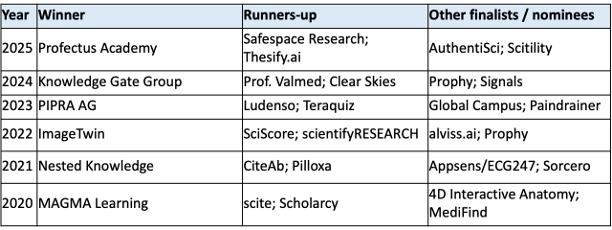
The winners are a mix of tools and services with wide applications across disciplines and the research cycle, and a more restricted focus on elements of health research (most notably PIPRA AG in 2023). This makes it a good bellwether of wider publisher-adjacent thinking in the industry, alongside other awards and grants like the ALPSP Award for Innovation in Publishing and Digital Science’s Catalyst programme.
There is a clear cluster of winners around pre-publication - Profectus Academy is a proposal development tool, Knowledge Gate Group assists with finding experts, Nested Knowledge supports collaborative systematic review. It is difficult to be precise without more systematic analysis, but my subjective view is that, while the emphasis on Health Sciences is very clear, the influence of Open Science and public engagement less so. Instead, the centre of gravity appears to lie in research culture and, more specifically, research integrity, and in innovations that will improve publishing workflows. None of these are mutually exclusive categories, but the balance suggests that practical, operational needs outweigh more aspirational commitments to openness or engagement. This is not a criticism; workflow efficiency and tools to improve research integrity are important and appropriate publisher priorities. There should be no surprise that winners and runners up offer improvements to areas such as quality control, reviewer selection, and integrity which are costly to manage.
AI is threaded throughout the runners and riders, and increasingly so in more recent years. It is mentioned explicitly in the published short descriptions for winners and nominees. AI is probably relevant to even more if one makes liberal assumptions about what is behind the technology deployed. This is not a surprise, though it is worth mentioning that by ‘AI’ I don’t mean Large Language Models, but rather specific applications using machine learning (ML) to offer solutions at various stages of the research workflow.
These tools quietly relied on ML before the generative AI explosion, and it is easy to retrospectively judge (or misjudge them) on that basis. It will be interesting to see how many future winners use the term ‘responsible’ in the context of their AI deployment.
Another pattern to note is that the startups that gained the most traction have been runners-up more consistently than they have been winners. This is another subjective view, but the runners-up seem to be the companies that have gone on to work in partnership with Karger – I have found announcements of partnerships with Scite and Ludenso but for none of the winners. There is strong overlap with the ALPSP award for those achieving significant traction – scite, Scholarcy, SciScore, Clear Skies, and Signals overlap the lists of winners and finalists for both between 2020–2024. There is no apparent overlap with winners of the Catalyst Grant, but Digital Science is focused on earlier-stage products and has a different priority each year, so this is unsurprising. This reflects the nature of a startup award like this – winning is less important than the prestige and the route to partnerships than the prize itself offers.
It will be interesting to see whether the OUP acquisition of Karger will change the balance of focus, and how winners and nominees progress. The strategic direction of the newly combined OUP/Karger entity is not yet apparent. Research integrity is a priority for OUP so it will be no surprise to see further integrity-driven innovation in future winners. OUP has a different approach on OA to Karger – the former focused on R&P agreements, the latter broadly utilising Subscribe2Open as well as Transformative Agreements – but this may not have any great impact given winners to date.
The acquisition could create a route to more opportunities for award winners and nominees. OUP’s scale could increase the scope for partnerships, as there will be more opportunities across the larger portfolio to innovate. However, the natural focus on synergies and the harmonisation of systems following any acquisition of this type may reduce the space for this kind of experimentation. For example, OUP’s AI Discovery Assistant, developed with Silverchair, will almost certainly be rolled out across Karger’s content at some stage. The effort required to undertake a project like this could limit the capacity to pursue parallel partnerships with nominees and winners. It will be interesting to see what partnerships emerge in future.
A final point is that these are not startups with grand plans to disrupt or completely reinvent scholarly communications and the research system. This stands in marked contrast to developments elsewhere in the research ecosystem including, in the last week, the announcement from the National Science Foundation (NSF) of the Tech Labs initiative, committing $10–50m per year per team to independent research groups designed to operate outside traditional institutional and funding constraints. The most radical experimentation is focused on the structure of how research is conducted and funded, well beyond the orbit of publishers and scholarly communications. This accords with observations I made after the thought-provoking Metascience conference in London in July, and which will form the basis of another post in the New Year.
Taken together, the past six years of Vesalius Award winners and nominees do not offer a roadmap for the future. The award tells us less about the future of research than about the present priorities of scholarly publishing, and where it sits in a rapidly changing research landscape.